Corrosion and Coatings Q&A
Chiara Sorrentino MRSC (Technical Director) and John Thomson (Director – SeaShield™) recently appeared in the January edition of World Pipelines Magazine for a Corrosion & Coatings Q&A covering the changing energy landscape and how coatings manufacturers are adapting to these evolving needs.
Looking ahead to 2026, what are the major corrosion and integrity challenges pipeline operators are bringing to you most often? Are these challenges different from what you were hearing five or ten years ago?
We have existed as a business since 1883; we take the long view. The much-awaited arrival of the hydrogen economy is following the same pattern of energy transition as the last 100 years. UK electricity generation in that period has seen considerable upheaval. But with each successive technological change the period of technological induction from initial onset to widescale adoption has spanned about 30 years. Of course, existing natural gas consumption is not only in electricity generation but is spread across domestic, commercial/industrial and transport sectors as well. The opportunities for hydrogen substitution face considerable efficiency, safety and infrastructure challenges especially in domestic and transport use sectors. It is highly commendable that pipeline operators strive to use existing infrastructure for new purposes. This not only makes economic sense but helps contribute to sustainability goals. We are actively working to support these new developments as well as ensuring continued support for existing requirements.
How have changing regulatory pressures, climate considerations, and the rise of CCUS/H₂ projects shaped operator expectations of coating performance?
The rise of carbon capture utilisation and storage (CCUS)/H2 will require the completion of many engineering validations to ensure the suitability of the existing pipeline network and the new additions to be incorporated within it. We feel that it is essential that coating manufacturers are included in these engineering validations to ensure a holistic view is taken of the use of coatings in a CCUS/H2 network.
We have been asked, “Are your coatings hydrogen ready?”, however this is not a simple question to answer, and anyone claiming that it is should be asked for justification. The question is not just on the effect of hydrogen on the coating, for example, but on how the use of the pipeline will change: what temperatures will it now operate at? Will new operating pressures potentially create temperature changes, or similar, that were previously unexpected?
Laboratory testing combined with field validation is a proven way to demonstrate the suitability of a coating for the intended purpose and this should be widely undertaken. While international and national standards also help shape development of coatings, these often follow developments in the market, rather than lead the market to the developments. As a company we are committed to assisting pipeline operators in achieving their objectives through collaboration.
Many operators now want coatings that provide long-term stability while reducing VOCs and environmental impact; how do you balance high performance with sustainability requirements?
Many suppliers have existing coatings that contain VOCs and work to reduce the quantity of VOC by reformulating the products according to market demands. In contrast, we have designed coatings that are inherently VOC free. While this provides obvious benefits to the pipeline operator, it also provides benefits to us as a manufacturer; a reduction in VOCs benefits the staff in our factory with improved working conditions, increased safety and reduces our impact on the local community. Eliminating VOCs from their products is something any reasonable company should be working towards.
We do not see reduction or elimination of VOCs as the only way to improve the sustainability of our product. For over 90 years we have manufactured and supplied types of coatings with some of the lowest surface preparation requirements of any coating available. We continue this with our new coating developments, working towards achieving the same performance on a surface that is prepared without abrasive blasting as one that is. These benefits contribute not only towards improved sustainability but also towards improved operator safety, another key ESG goal that all companies should be working towards.
Throughout these developments, we ensure the high performance of our coatings is maintained by benchmarking them against the requirements of international and national standards, undertaking long term testing and continued collaboration with valued partners who enable field validations of these new developments.
Can you describe any advancements you have made in field-applied or rehabilitation coatings?
We have been supplying a high build epoxy coating (Protal) for 40 years which has been extensively used in pipeline rehabilitation. Typically, this is done on pipelines where the existing coating was a Coal Tar Epoxy or similar coating that is no longer available, and which is being replaced with a VOC-free epoxy coating with a greatly reduced environmental impact.
We are increasingly using our viscoelastic range of coatings for rehabilitation. The Viscotaq range of coatings is highly user friendly, due to the simple surface preparation requirements, ease of application in a wide range of environments, and fast return to service due to their typically being no cure time to any component in the system.
What are the most common mistakes or oversights you see during coating application in the field?
Three common mistakes are incorrect material selection, incorrect surface preparation, and insufficient consideration of the environmental conditions. Generally, all these mistakes are avoidable. All coatings manufacturers should be happy and able to provide guidance at the design stage in what would be the appropriate products or systems for a particular project. Once the system is known, the manufacturer can also provide guidance on how to complete suitable surface preparation and how to suitably manage the environmental conditions to ensure a successful coating application.
Much of this comes down to engagement and collaboration. We offer training to help ensure the system is applied correctly according to our instructions, and we are also always prepared to assist at the design stage to try and get the correct products specified, even if that means on occasion, we have to say we do not have a suitable product or system for the project.
How do you address the demands of difficult environments?
We are fortunate that our range of products covers a wide variety of environments, so we are able to tailor those products to create a system that will be suitable for almost any environment. By collaborating with operators and encouraging the open sharing of information, we can identify the difficulties that need to be overcome and mutually agree on the best solution to resolve them.
Can you share any recent project examples that highlight the strengths of your coating systems in challenging applications?
Our Viscotaq range of viscoelastic coatings have recently been used on several projects, all with very different requirements, highlighting the versatility and adaptability of this range of products.
One of our viscoelastic systems was applied as a factory coating to a large diameter (1200mm & 1400mm) 12km water pipeline (Fig 1,2 and 3). The system’s ability to ‘self-heal’ was a key factor in its selection, with the speed of application also of great importance. The two layer system of viscoelastic inner layer and PE outer layer was cold applied and had no cure time, meaning the coating application could keep up with the rate of surface preparation.
Another of our viscoelastic systems was applied as a field joint coating to a large diameter (1422mm) 300km onshore pipeline, buried in the desert of the GCC. The simple application of the system made it very contractor friendly, allowing for a fast completion of each field joint (Fig 4.).
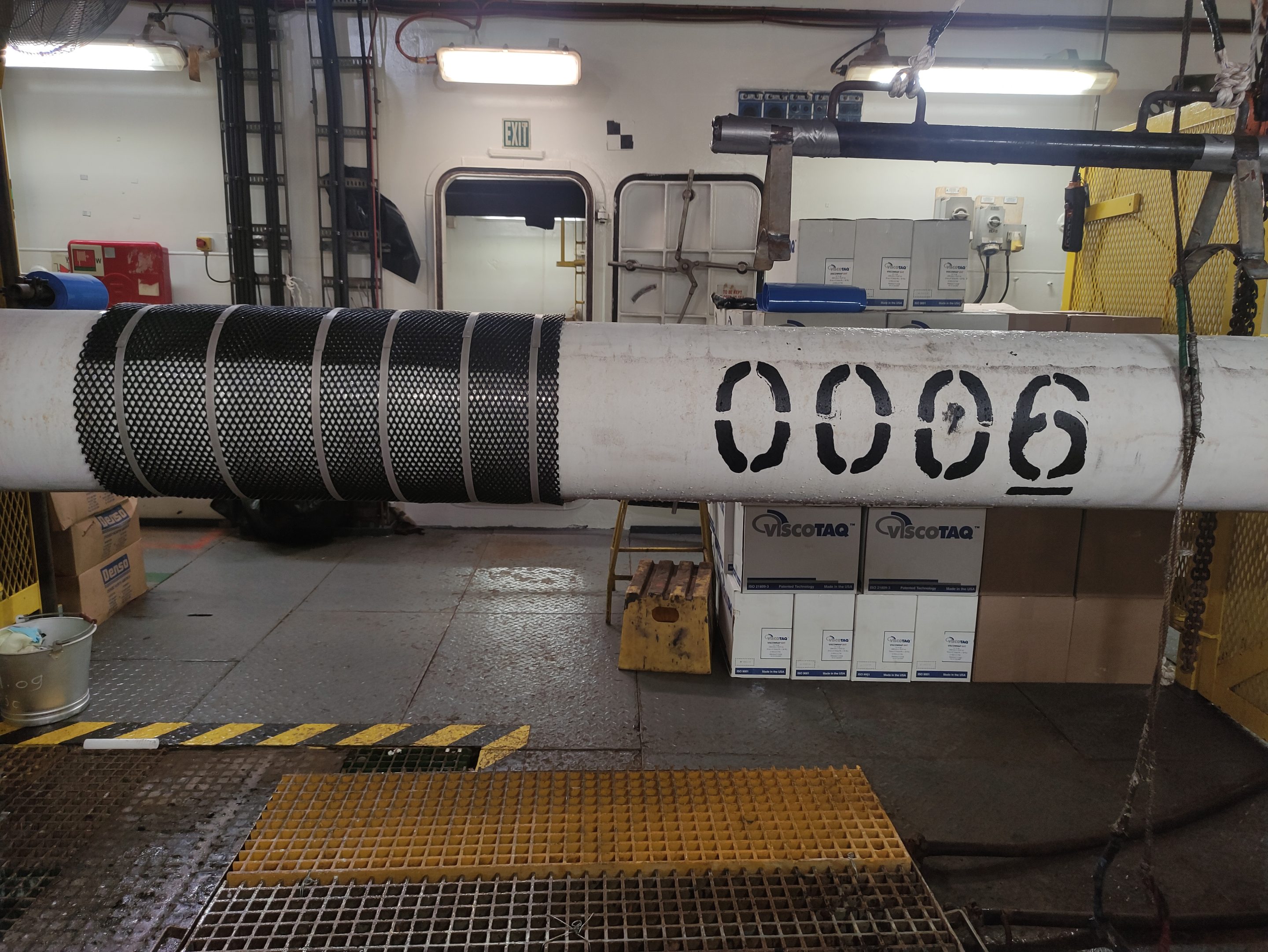
A third viscoelastic system was applied as a field joint coating to offshore pipelines 304mm and 355mm in diameter with a combined length of 60km (Fig 5.). The pipelines were operating with a potential peak service temperature of 115°C requiring a specialist system. The system also had to be installed very quickly to meet the tight schedule of the lay barge. The system was combined with a project specific installation method to ensure that the project schedule was met and minimal repairs required despite the harsh operating environment on the lay barge.
A common theme with all these projects was speed of application; this is achieved with simple application methods and low surface preparation requirements. This means that our viscoelastic systems can often be applied faster than traditional coatings, giving a key opportunity for savings, in almost any environment.


Fig 1. Pipe lengths coated with Denso™ Viscotaq™ tape wrap system at the pipe mill.

Fig 2. Denso™ Viscotaq™ coated pipe lengths in storage at the pipe mill yard, awaiting delivery to the pipe construction site.

Fig 3. Successful installation of Denso™ Viscotaq™ coated pipes through rough terrain in KwaZulu-Natal, South Africa.

Fig 4. Large diameter (1422mm) 300km onshore pipeline in the GCC coated with Denso Viscotaq™.